

Math Solitaire: Brain Puzzle
Smart Project GMBH
I found Math Solitaire: Brain Puzzle most interesting when I treated it as a small shared-device activity rather than a replacement for a full card game or a serious mathematics course. It combines solitaire-style card play with arithmetic tasks, so a person can pick it up for a short mental workout and another household member can use the same device later without needing a complicated setup. That simple handoff is the main reason I can imagine recommending it to a family or to someone who enjoys quiet puzzle sessions.
The game is free, belongs to the card category, and comes from Smart Project GMBH. Its basic idea is easy to understand: arrange or use cards while solving calculations, with the goal of making ordinary arithmetic feel more like play. I like that combination because it gives the familiar patience of solitaire a more active purpose. You are not only looking for legal card moves; you are also deciding how to approach an equation and checking whether your next choice keeps the puzzle manageable.
At the same time, I would set expectations carefully. This is a focused brain-puzzle game, not a broad collection of card modes, a social card room, or a structured learning platform. If you want competitive matches, deep progression, or detailed lessons explaining every mathematical step, this is probably not the right place to start. If you want a compact activity that asks you to think before tapping, it has a clearer appeal.
How Math Solitaire works on a shared device
A practical household scenario
Imagine leaving a phone or tablet on a kitchen table while waiting for dinner. One person can play a few rounds to break up idle time, then pass the device to someone else without the activity becoming a group commitment. A parent might enjoy the card structure, a teenager might prefer the calculation challenge, and another adult might simply use it as a short distraction between chores. The important point is that each player can approach the same puzzle style at a different pace.
I think this works better for shared use than many competitive card games because the experience does not depend on everyone being online at the same moment. There is no need to organize a match or agree on a long session. The game suits those small gaps when one person has a few minutes and another person will use the device later. That makes it more realistic for a household with one commonly used tablet than an app built around individual accounts and constant participation.
Related News






There is also a useful difference between watching someone solve a normal solitaire board and watching them work through a mathematical card puzzle. With the latter, a second person can contribute by checking an operation, suggesting a move, or noticing a safer sequence. That creates light coordination without turning the game into a formal lesson. I would not call it a complete multiplayer experience, but it can support a quiet, cooperative moment around the same screen.
What to decide before handing over the device
Because it is designed as a self-contained puzzle game, I would establish a simple household routine before sharing it. Decide whether the device is being used for individual turns, casual collaboration, or a quick challenge between players. That sounds minor, but card puzzles can become frustrating when one person changes a move halfway through another person’s plan. Taking turns clearly is especially helpful when the player is still learning how the arithmetic and card choices interact.
I would also avoid treating a completed board as a shared score unless everyone agrees on what counts as a fair comparison. A younger player may be concentrating on understanding the equations, while an experienced solitaire player may be concentrating on avoiding dead ends. Those are different goals. Comparing speed or success without considering that difference can make a relaxed puzzle feel unnecessarily competitive.
Gallery
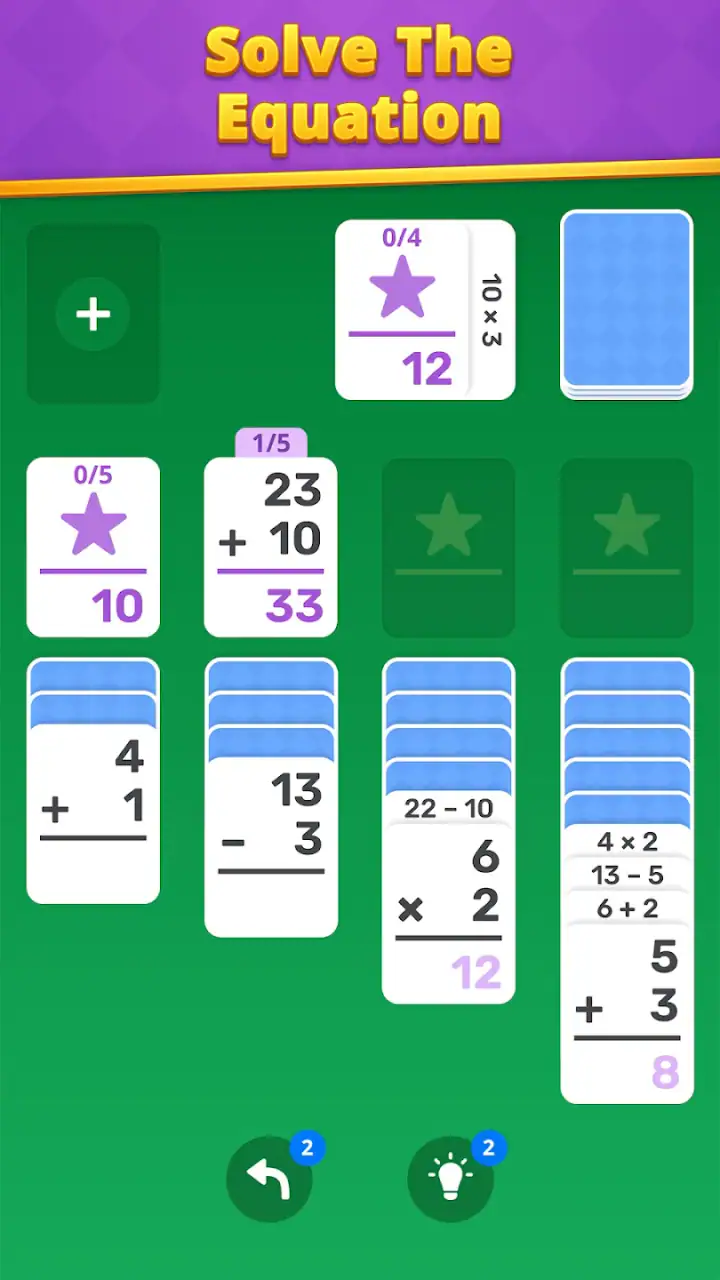
Another useful habit is to let each player finish a thought before offering help. The mathematical part encourages people to call out answers quickly, but the real challenge is often choosing when to use an answer and when to preserve a card or option. If someone is using the game to train concentration, constant hints remove part of the value. In my experience, the best shared sessions involve questions such as “What options do you see?” rather than immediately giving the move away.
Account boundaries and personal progress
Shared-device use has a practical limitation: a single installation does not automatically mean that every person has a separate personal space. I would not assume that the game provides household profiles, child accounts, or a private progress system. If several people use the same device, agree on whether the current state belongs to one regular player or is simply open for anyone to continue. That small boundary prevents confusion and avoids presenting someone else’s unfinished puzzle as a mistake.
For a private routine, I would use the game mainly on my own phone and keep household play on a tablet when possible. That separates a personal mental-training habit from casual group use. If only one device is available, a simple verbal rule works: do not reset another person’s active puzzle, and ask before starting a new session. These are not features of the game; they are sensible ways to make a shared installation less awkward.
This matters because solitaire-style games often reward remembering the current arrangement. A player may have deliberately left a card available for a later equation, so another person changing the board can erase the reasoning that made the puzzle interesting. The same issue applies to children who are learning: preserving their unfinished attempt gives them a chance to return and understand what happened instead of seeing a completely different position.
Coordinating play without turning it into homework
The arithmetic focus makes this game suitable for short, low-pressure practice, but I would keep the tone playful. It can be useful after school or during a quiet break when someone wants to exercise basic calculation, yet I would not present every session as a test. The card layer gives the activity a reason to continue even when the player is not actively looking for formal study.
A good household approach is to separate help into two stages. First, ask the player to read the calculation aloud and explain what they think it allows. Second, discuss the card consequence: which option keeps the board flexible, and which option may leave fewer choices later. This turns a quick answer into a small planning exercise. It is one of the more valuable ways to use the game, because arithmetic accuracy alone does not guarantee a good solitaire decision.
I also found that alternating roles can make the game more engaging. One person can solve the calculation while the other looks at the available card routes, then they switch for the next decision. This is particularly useful when a child is more comfortable with numbers than with planning, or when an adult wants to participate without taking control of the entire puzzle. The arrangement keeps the activity cooperative while preserving the game’s individual logic.
There is a trade-off here. Collaboration can make difficult problems less intimidating, but it can also hide whether the player can solve them independently. If the goal is practice, I would allow a quiet first attempt before discussing the answer. If the goal is simply shared entertainment, I would be more relaxed and treat the equations as conversation starters rather than performance checks.
Age context and trust
The content rating is Everyone, which makes the game easier to consider for a mixed-age household. The central activity is card play and calculation, so the concept is approachable for children who are ready for the level of arithmetic involved and for adults who enjoy mental puzzles. Still, an Everyone rating does not tell me that every child will find the difficulty comfortable. A younger player may understand the cards but need help with the equations, while an older child may find the calculations simple and focus mainly on planning.
I would introduce it by playing alongside the child once rather than handing over the device with no explanation. That first session reveals whether the challenge feels motivating or discouraging. It also lets an adult explain that an unsuccessful attempt is part of the puzzle, not a sign that the player has done something wrong. Since the game combines two kinds of thinking, frustration can come from the arithmetic, the card arrangement, or the interaction between them.
For trust and privacy, I would use the same ordinary care I apply to any game on a shared device. The developer is Smart Project GMBH, and the game is available at no cost, but those facts do not replace checking the device’s own family rules or supervision habits. I would keep the device’s general account settings under the owner’s control and avoid assuming that the game itself manages separate household permissions.
That distinction is important for parents. The game can be age-appropriate in subject matter while still requiring an adult to decide when and how the device is used. If a child needs strict time limits, a separate child profile, or tightly managed access, those decisions should be handled at the device level rather than expected from this puzzle alone.
Where it beats ordinary solitaire and where it does not
Compared with traditional solitaire, the strongest difference is that every move can carry a calculation question. Standard solitaire is excellent for visual sequencing and patience, but it may become a familiar routine once the player knows the patterns. This game adds a second layer that interrupts automatic play. I have to consider the numerical result and the card consequence together, which gives a short session more mental variety.
Compared with a dedicated math-practice app, the advantage is the card context. The game does not feel like a worksheet because the answer is connected to a board and a choice. That can help a player who resists direct drills but enjoys puzzles. The limitation is equally clear: anyone looking for explanations, curriculum-based progression, or a carefully organized lesson path will likely be better served by an educational app built specifically for teaching.
It also differs from a regular digital card game that emphasizes atmosphere, collection, or competition. Here, the arithmetic is not decoration; it shapes the reason to play. That makes the experience more purposeful, but it may reduce its appeal for someone who wants a purely relaxing card game with no mental calculation. I would choose ordinary solitaire for effortless winding down and this game when I want my attention engaged.
Players should also consider screen size. On a phone, the compact format is convenient for a quick turn, but cards and equations compete for limited space. A tablet is more comfortable for two people looking at the same board or for a child who benefits from a larger display. I would not treat that as a flaw in the game itself, but it changes how well the shared-use idea works in practice.
Small strategies that improve the experience
My first practical tip is to read the whole calculation before tapping. It is tempting to react to the most obvious card, especially when the answer seems easy. The better move may be the one that leaves more useful cards available afterward. This is where the game becomes more than arithmetic flash cards: the correct result still has to fit the broader card situation.
Second, use mistakes as information rather than immediately restarting. If a sequence leaves no comfortable route, look back at the point where the board became narrow. That review can reveal whether the problem was a wrong calculation or a card decision that spent a flexible option too early. I find this more productive than focusing only on whether the final board was cleared.
Third, vary the player’s role during shared sessions. A child who always receives the answer may enjoy the game but gain less from it. Let them explain the number first, then ask another player to check the card implications. Adults can also benefit from this arrangement because it exposes whether they are solving logically or simply relying on familiar solitaire habits.
Finally, keep sessions short when attention drops. The game is well suited to a few deliberate rounds, but extending a puzzle after concentration has gone can turn a useful challenge into tapping by habit. I prefer stopping after a thoughtful attempt and returning later, particularly when using it as a household activity rather than as a personal marathon.
Who should install it, and who should skip it?
I would recommend it to people who already enjoy solitaire but want more decision-making, to families looking for a quiet shared activity, and to adults who like mental arithmetic in a game format. It is also a reasonable choice for someone who wants a free card game with an educational edge rather than a large, feature-heavy entertainment package.
I would skip it if your main goal is competitive play, social matchmaking, rich card-game variety, or a formal math curriculum. I would also be cautious about choosing it for a child who becomes upset by mixed difficulty, because the combination of equations and card planning may feel harder than either activity alone. In that case, a simpler arithmetic game or a more forgiving solitaire version may be a better first step.
The current version is 1.15.2288 and it requires Android 7.0 or later. That makes the compatibility question straightforward for many Android users, but anyone sharing an older device should check the operating system before planning household use. I would also remember that the game is free, so the financial barrier is low, while the real question is whether its particular blend of cards and calculations matches the player’s expectations.
My household verdict
After using it as both a solo puzzle and a shared-device activity, I see Math Solitaire: Brain Puzzle as a focused option with a clear identity. Its best quality is the way it joins familiar card planning to arithmetic without requiring a long explanation. That makes it easy to pass around the household, easy to discuss, and useful for short sessions where people want something more active than ordinary solitaire.
The audience response is mixed but substantial: it holds a 3.4 average from around 2.4 thousand ratings, with more than 500 thousand installs. I read that as a reason to keep expectations balanced rather than as a verdict by itself. The game has found a sizeable audience, but its specific combination will naturally appeal more to puzzle-minded players than to people seeking a pure card diversion.
For me, the deciding question is whether you want the cards and the calculations to influence each other. If yes, this is an approachable free game to try, especially on a shared tablet where family members can take turns or solve a board together. If you want separate profiles, formal teaching tools, competitive card play, or a completely relaxing experience, I would choose a different category of app. Within its narrower purpose, though, it offers a sensible way to turn a few spare minutes into a small exercise in accuracy, patience, and planning.
FAQs for Math Solitaire: Brain Puzzle
What is Math Solitaire: Brain Puzzle?
Math Solitaire: Brain Puzzle is a number-based puzzle game that combines simple solitaire-style gameplay with mental arithmetic challenges. Instead of only arranging cards, you solve equations and use logical thinking to progress through levels. The game is designed for short sessions, making it suitable for players who enjoy casual brain-training games, number puzzles, and gradually increasing challenges.
How do you play Math Solitaire: Brain Puzzle?
Gameplay generally requires you to select, combine, or arrange numbered cards according to the mathematical objective shown on screen. Each puzzle has a target solution, so you need to calculate carefully while deciding which moves to make first. The rules are easy to understand, but later stages may require planning, quick mental math, and efficient use of the available cards.
Is Math Solitaire: Brain Puzzle suitable for children and beginners?
The game can be suitable for children, students, and adults who are comfortable with basic arithmetic. Early puzzles usually provide a gentle introduction, allowing beginners to understand the card and number mechanics before the difficulty increases. However, younger players may need help with more advanced challenges, and parents should check the game’s content, advertisements, and purchase settings before allowing independent play.
Can Math Solitaire: Brain Puzzle be played offline?
Some parts of Math Solitaire: Brain Puzzle may work without a continuous internet connection, especially the core single-player puzzles. Nevertheless, online access can still be required for advertisements, rewards, cloud features, updates, analytics, or promotional content. Offline availability may also differ between Android and iOS versions, so it is best to test the game after installation rather than assume every feature works without internet.
Does Math Solitaire: Brain Puzzle contain ads or in-app purchases?
Like many free-to-download puzzle games, Math Solitaire: Brain Puzzle may include advertising and optional in-app purchases. Ads can sometimes appear between levels or when you request extra hints, while purchases may offer currency, boosters, ad removal, or other conveniences. Before downloading, review the store listing and device purchase settings, particularly if children will play or if you prefer a completely uninterrupted experience.
Pros
- Combines card gameplay with quick arithmetic challenges.
- Short rounds make it easy to play during brief breaks.
- Gradually increasing difficulty keeps puzzles engaging.
- Helps practice mental addition
- subtraction
- multiplication
- and division.
- Simple rules make it accessible to casual puzzle players.
Cons
- Some puzzles may feel repetitive after extended play sessions.
- Higher difficulty can be frustrating without hints or retries.
- Progress may depend on ads or optional in-app purchases.
- Players seeking traditional solitaire may dislike the math focus.
- Small cards or numbers can be harder to read on compact screens.


